

Pricing swim lessons is more complex than pricing most children's activities because the cost structure is different. A dance studio or martial arts school with owned or leased space has relatively predictable fixed costs. A swim school renting pool time pays for a commodity that fluctuates significantly by facility, time slot, and geography. That pool rental cost, which can run anywhere from $30 to $200 per hour depending on where you operate, is the dominant variable in any swim lesson pricing calculation.
Get the pricing wrong in one direction and you are running classes that do not cover your costs. Get it wrong in the other direction and you are losing students to competitors and underutilizing your pool hours. This guide covers how to build a pricing model for swim lessons that covers your costs, reflects your value, and supports a sustainable business.
Start With Your Costs, Not Your Competitors
The instinct when setting prices is to look at what other swim schools in the area charge and price near them. That is useful as a final check, but it is the wrong starting point. A competitor who has owned their facility for 15 years has a completely different cost structure than a swim school renting pool time from a community center at market rates. Matching their pricing without understanding their cost structure will not tell you whether that price is viable for your operation.
1. Calculate your fully loaded cost per lesson
Before setting any price, calculate what each lesson actually costs you to deliver. This calculation varies by class format, but the structure is the same.
Pool rental is typically your largest cost. If you are renting pool time, note the per-hour rate for the time slot and the portion of the pool you are renting. If you rent a full pool for $120/hour and run four simultaneous lanes with one instructor per lane, your pool cost per lane per hour is $30. If you rent a single lane at $45/hour, your pool cost per lane is $45.
Instructor cost depends on whether instructors are employees or contractors and what rate you pay. Entry-level swim instructors typically earn $15 to $22/hour. Experienced or Red Cross Water Safety Instructor (WSI) certified instructors earn $22 to $40/hour. For a 30-minute group class, instructor cost per session is half the hourly rate.
Overhead allocation covers your share of insurance, administrative costs, software, marketing, and any other operating expenses that support the class but are not directly attached to it. A simple approach is to take your total monthly overhead and divide it by your total monthly class hours to get a per-hour overhead figure, then allocate half that figure to a 30-minute class.
Once you have pool cost, instructor cost, and overhead for a given class, divide the total by the number of students in the class to get your cost per student per lesson. Add your target margin above that to arrive at your minimum price per lesson.
2. Work through a concrete example
Suppose you rent a lane at $50/hour. Your instructor earns $25/hour. Your per-hour overhead allocation is $15. For a 30-minute group class with six students:
Pool cost for 30 minutes: $25. Instructor cost for 30 minutes: $12.50. Overhead for 30 minutes: $7.50. Total cost for the class: $45. Cost per student with six students enrolled: $7.50.
At a 50% margin, you would need to charge $11.25 per lesson. At a 60% margin, you would need $18.75 per lesson. At the lower end of the typical group lesson market rate of $15 to $25 per lesson, you have viable margin at six students.
Now run the same calculation with four students instead of six. Cost per student rises to $11.25. A 60% margin price would be $28.13. That may be at or above your local market rate for a group class, which means you need either minimum class size enforcement or a higher facility to maintain profitability at smaller class sizes.
Running this calculation before opening enrollment tells you your minimum class size, your minimum price, and the margin you can expect at different enrollment levels.
Pricing by Class Format
Swim schools typically offer multiple class formats at different price points. Each format has different cost and value characteristics that justify different pricing.
a. Group lessons
Group lessons are the core offering at most swim schools and the entry point for the majority of enrolled students. Standard group lesson sizes run four to eight students per instructor, with ratios typically mandated by the age and skill level of the swimmers. Younger students and beginners require lower ratios.
Group lesson rates at learn-to-swim programs across North America typically range from $15 to $35 per session when sold as part of a monthly enrollment, and $20 to $45 per session when sold as individual drop-ins. Urban markets and high-income suburban areas are at the upper end of these ranges. Smaller cities and rural markets are at the lower end.
Monthly tuition for two group lessons per week typically runs $80 to $160 depending on session length and location. For three lessons per week, $120 to $220 is typical. Selling monthly tuition rather than per-session is significantly better for your cash flow and simplifies billing.
b. Semi-private lessons
Semi-private lessons serve two to three students, typically friends or siblings at similar skill levels. The cost per student is higher than a group lesson because the pool-to-student ratio is less efficient. Pricing typically runs $25 to $55 per student per session.
Semi-private lessons are a useful middle tier between group and private instruction, particularly for older students or those with specific skill goals who benefit from more individual attention but whose families are not ready for private lesson pricing.
c. Private lessons
Private one-on-one swim instruction commands a significant premium over group lessons because the instructor's attention is undivided and the pool time is allocated exclusively to one student. Private swim lessons at most North American swim schools run $45 to $100 per 30-minute session, with 45-minute and 60-minute sessions priced proportionally higher.
Factors that justify the upper end of the private lesson range include an instructor with specialized credentials (ASCA certified coach, competitive swimming background, therapeutic swim experience), a student with specific performance goals such as competitive swim team preparation or stroke correction, and a facility with premium amenities.
For private lessons, selling session packages, for example a 10-session block at a slight discount from the per-session rate, is standard practice. It collects revenue upfront, locks in the student for a defined period, and signals commitment from both sides.
d. Parent-child and infant programs
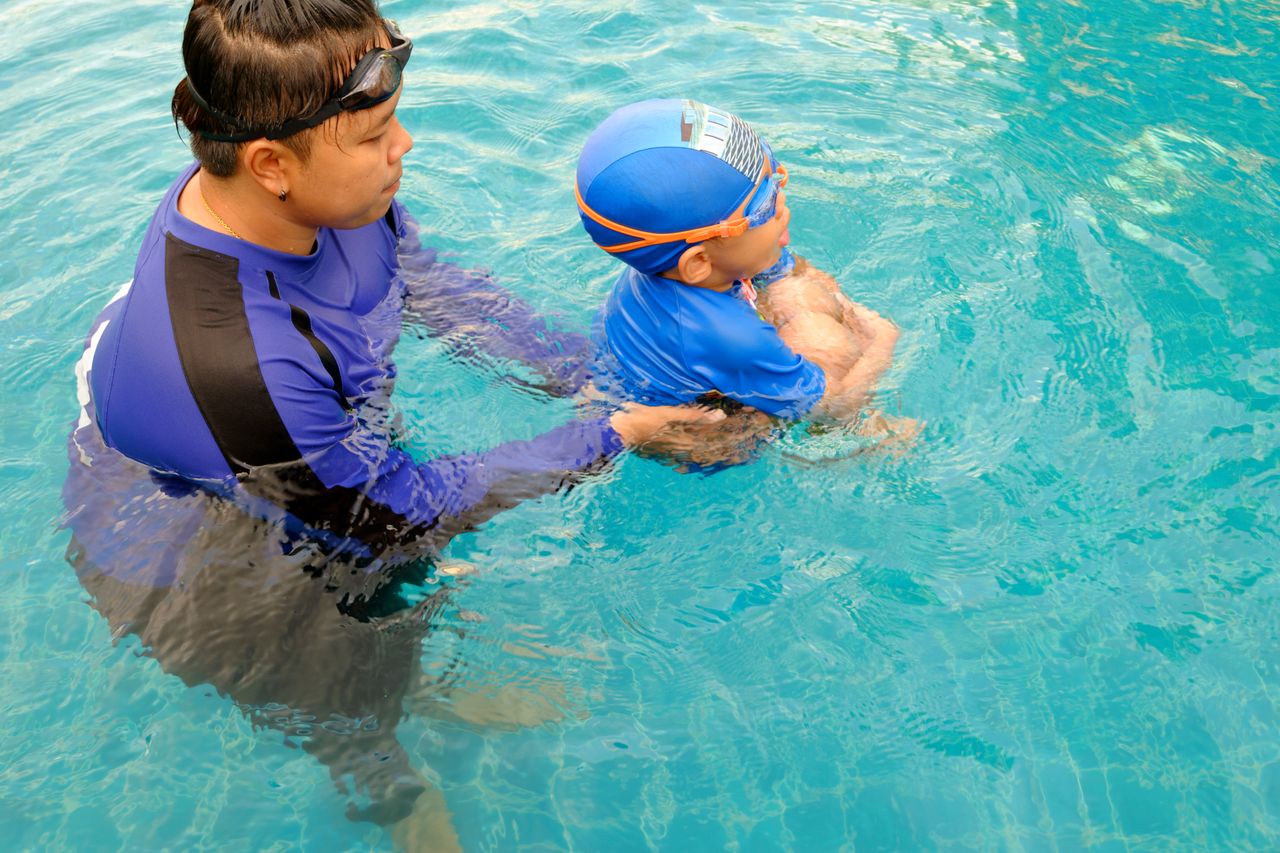
Parent-child programs for infants and toddlers, typically ages six months to three years, are priced differently from learn-to-swim programs because the objective is water familiarity and safety rather than independent swimming skill. These programs often run 30 minutes with a higher per-minute cost than group lessons because of the specialized nature of infant aquatics instruction and the emotional value parents attach to early water safety.
Parent-child program rates typically run $18 to $35 per session as part of a monthly enrollment. The parent's presence means no supervised ratio concerns beyond pool safety, so class sizes can be slightly larger, up to eight to ten parent-child pairs.
e. Intensive and holiday programs
Summer intensive programs and holiday week swim camps command premium pricing because of their concentrated format and the strong demand during peak periods. A week-long summer swim intensive, four or five days with 45 to 60 minutes of instruction per day, typically prices in the range of $150 to $350 per student depending on group size and location.
These short-format programs are also a useful marketing tool. Students who attend a holiday intensive and make rapid progress are prime candidates to convert to year-round enrollment.
Pricing Models: Monthly Tuition vs. Per-Session
The billing model you choose affects not just cash flow but also your retention rates and the level of administrative work your business requires.
1. Monthly tuition (recommended for ongoing programs)
Monthly tuition treats swim lessons as an ongoing enrollment, similar to a gymnastics or dance program. Students pay a fixed monthly fee for a set number of sessions per week, billing runs automatically on the same date each month, and the expectation is ongoing participation across the school year.
Monthly billing is significantly better for your business than per-session billing. It creates predictable revenue, reduces billing administration to a single automated cycle per month, and reduces the friction of a family deciding whether to attend each week. Students on monthly tuition attend more consistently because the cost is already paid.
The practical challenge with monthly billing is handling months with different numbers of sessions due to holidays, pool closures, or schedule changes. The standard approach is to set a monthly rate based on an average session count per month, four weeks with two sessions per week equals eight sessions per month, and handle occasional session shortfalls through makeup credits rather than prorated adjustments.
2. Session packages
Session packs, typically 10 or 12 lessons sold upfront at a slight discount from the per-session rate, work well for families who are hesitant to commit to ongoing enrollment but want more than a single trial. A 10-session package sold at 10 to 15 percent below the per-session rate gives the family a sense of value while locking in revenue for you before the sessions are delivered.
Session packs work best for private lessons and semi-private lessons where families are actively managing their child's skill development toward a defined goal. They are less ideal for group programs where ongoing enrollment is the natural format.
3. Drop-in rates
Drop-in rates are a premium pricing tier, typically 20 to 40 percent above the per-session equivalent from a monthly enrollment, that accommodate families who want flexibility without commitment. Drop-ins are useful for filling spots in underenrolled classes, for visiting students who want to attend while traveling, and as a sampling option for families considering enrollment.
Do not build your primary business model around drop-in attendance. Drop-in families have no commitment to your program and fill and vacate spots unpredictably, which makes class planning and instructor scheduling unreliable.
Pricing by Swimmer Level and Age
a. Infant and toddler programs (ages 6 months to 3 years)
Parent-child programs carry a moderate premium over standard group lessons because of their emotional value to families and the specialized nature of infant aquatics. Price the same as or slightly above your entry-level group lessons.
b. Learn-to-swim (ages 3 to 12)
This is your highest-volume segment and the core of most swim school programs. Pricing should be set at the middle of your local market range for comparable group sizes and session lengths. Being competitive in this segment drives enrollment volume, which supports the overhead structure that allows your other programs to be profitable.
c. Teen and adult lessons
Adult swim lessons are frequently priced at a 10 to 25 percent premium above equivalent youth group lessons. Adults are often more motivated, more consistent in attendance, and willing to pay more for an activity tied to health, safety, and personal achievement. Adult private lessons particularly command higher rates than youth private lessons at many schools.
d. Competitive swim preparation
Students training for competitive swimming or working with a certified ASCA coach on stroke technique and race-specific skills should be priced at the upper end of your range. The coaching expertise, performance outcomes, and specificity of the instruction justify premium positioning. These students are also typically more committed and more likely to continue long-term.
How to Research Competitive Pricing in Your Market
Search and call locally
The simplest research method is to search for swim schools within 15 to 20 minutes of your location and check their published rates. Many swim schools do not publish all of their pricing online, which means calling as a prospective parent is necessary to get a complete picture. Note the price, session length, class size, and any details about facility quality or instructor credentials that might justify different positioning.
Evaluate the full value, not just the number
A YMCA program charging $12 per session in a community pool with rotating instructors is not the same product as a private swim school charging $25 per session with dedicated instructors and an owned or long-term leased facility. You do not need to match the YMCA's pricing if your program delivers meaningfully better outcomes, consistency, or experience. Identify the segment of families willing to pay for the differentiated experience and price for them rather than trying to compete across all price sensitivity levels.
Adjust for facility and credentials
If your facility is newer, cleaner, or more conveniently located than a competitor, a 10 to 20 percent price premium is defensible. If your instructors hold higher credentials (ASCA certification, competitive coaching backgrounds, therapeutic swim training) than what the local market offers, that differentiation also justifies premium pricing. Price premiums require you to articulate the difference clearly in your marketing so families understand what they are paying for.
When and How to Raise Prices
1. Raise prices annually
Price increases at or slightly above inflation, typically 3 to 8 percent per year, are easier to sustain than larger increases every several years. Families who have been enrolled for one year are generally comfortable with a modest annual adjustment if they feel the program is delivering value. Families who have been enrolled for three years and never seen a price change are often more resistant to a catch-up increase that tries to close a larger gap all at once.
2. Give advance notice
Announce price increases at least 30 to 60 days before they take effect. For families on monthly billing, a billing date change or an increase to the monthly amount should arrive well in advance so families can plan. A personal email from the school director explaining the increase, framing it around improved instruction, facility investments, or rising operational costs, is more effective than a generic notice attached to an invoice.
3. Grandfather existing families for one cycle
For significant price increases, grandfathering existing families at the current rate for one additional enrollment cycle while new enrollments start at the new rate softens the impact and rewards loyalty. This approach works well when you are repositioning your pricing upward or introducing a new rate structure.
4. Raise rates for new students first
If you are uncertain how the market will respond to a price increase, raise your published rates for new enrollments only and leave existing families at their current rate for the next term. This tests market response without risking your existing enrolled base. If new enrollment at the higher rate holds steady, roll the increase to existing families at the next renewal.

Common Swim School Pricing Mistakes
Underpricing because you are new
New swim schools often underprice to attract initial enrollment, which is understandable, but the floor should still be your cost per lesson plus a minimum margin. Pricing below cost to build volume is not a viable strategy for a business that depends on consistent revenue to cover pool rental and instructor costs. Start at a price you can sustain, even if it means slower initial growth, and save discounts for specific trial offers rather than building them into your base rate.
Not accounting for pool rental in lesson pricing
Pool rental is a per-class-hour cost, not a monthly overhead figure to allocate at the end. If you are renting pool time, your pricing calculation must start with that per-hour cost before adding instructor pay and overhead. Schools that think of pool rental as a fixed monthly overhead tend to underprice individual lessons because they are not tracking the per-class cost accurately.
Pricing groups and privates too close together
If your private lesson rate is only $10 to $15 more than your group lesson rate, families will choose private lessons because the value difference is clear and the cost difference is small. This shifts your enrollment toward a higher-cost format (one instructor per student vs. one per six) without generating the proportional revenue increase needed to cover that cost. Private lessons should be priced at least two to three times the per-student group lesson rate to reflect the actual value and cost difference.
Not raising prices for years
A swim school that has not adjusted its pricing in three to five years is effectively running a discount program relative to its costs. Operating costs rise every year through facility rent increases, instructor pay increases, insurance renewals, and general inflation. If your pricing is not tracking those increases, your margins are compressing quietly. An annual pricing review and modest adjustment is healthier than a large catch-up increase after several years of flat rates.
Managing Billing for Multiple Price Tiers
Running group lessons, semi-private lessons, private lessons, and session packages simultaneously creates billing complexity that manual systems cannot handle cleanly. Different students on different pricing structures, some on monthly tuition and some on session packs, with makeups, sibling discounts, and mid-month enrollment changes, make reconciliation time-consuming and error-prone.
Classcard handles multi-tier billing for swim schools at a flat $99/month regardless of how many students are enrolled. Each student's billing is configured at enrollment and runs automatically on the billing date. Families with multiple children under one account are billed on one payment relationship. Failed payments retry automatically and notify the family without staff involvement. The dashboard shows your payment status across all enrolled students in real time, which eliminates the manual reconciliation step that eats time at the end of every billing cycle.
Frequently Asked Questions
What is a typical price for swim lessons in 2026?
Group swim lessons at private swim schools in North American markets typically run $15 to $35 per session as part of a monthly enrollment. Semi-private lessons run $25 to $55 per student per session. Private lessons run $45 to $100 per 30-minute session. YMCA and community center programs are often lower. Prices vary significantly by region, with urban markets and coastal cities at the higher end of these ranges.
Should I charge more for shorter or longer sessions?
Session length should be reflected in your pricing, but not linearly. A 45-minute lesson is not necessarily worth 50 percent more than a 30-minute lesson, because much of the value of a swim lesson is in the instructor's total attention across the session rather than in the raw minutes. A common approach is to add 20 to 30 percent to the 30-minute rate for a 45-minute session and 40 to 50 percent for a 60-minute session. For very young children, 30 minutes is often the appropriate session length regardless of how long a parent might prefer.
How do I compete with YMCA pricing?
Competing with YMCA pricing directly is rarely a winning strategy for a private swim school. YMCAs have subsidized facility costs, membership-based operational models, and access to bulk programming budgets that private schools cannot match per session. The more effective approach is to differentiate on consistency (same instructor across the term), smaller class sizes, specialized programs, or results, and to price at a premium that reflects those differences. The families who value consistency and instruction quality will pay for it. The families who primarily want the lowest price will choose the Y, and that is an acceptable outcome.
How do I price swim lessons for students with disabilities or special needs?
Therapeutic swim instruction and adaptive aquatics require specialized instructor training, smaller student-to-instructor ratios, and often additional preparation time for each session. These factors justify pricing at or above your private lesson rate, even for small group formats. If you work with students who have IEPs or therapeutic needs, document the instructor credentials and program adaptations clearly in your materials, as families who need this service are willing to pay for demonstrated expertise.
Should sibling discounts be built into my pricing?
Sibling discounts are common in swim schools and are a reasonable retention and enrollment tool, but they should be applied at enrollment rather than expected by default. A typical structure is 5 to 10 percent off the tuition for a second child enrolled under the same family account, applied automatically. More than 10 percent off for siblings begins to meaningfully reduce your per-student revenue in a cost structure where your pool rental and instructor costs are fixed per class regardless of family discounting.
How much should I charge for makeup lessons?
Makeup lessons are most cleanly handled as a credit system rather than separate pricing. A student who misses a scheduled class receives a makeup credit that can be applied to a future class at the same or lower level within a defined window, typically 30 to 60 days. This avoids creating a separate pricing question every time a student misses a class. If you do charge separately for makeup sessions, price them at your drop-in rate to maintain consistency with your general walk-in pricing structure.