

The U.S. martial arts industry is worth over $21 billion and has been growing at more than 6% annually. Waitlists are common at well-run schools, student lifetime values regularly stretch three years or more, and the product (genuine skill development with visible progress milestones) sells itself when you deliver it well. What doesn't sell itself is the business behind it.
Most dojos that close in the first two years don't fail because the instruction was bad. They fail because the owner didn't treat it like a business from day one. This guide covers everything you need to do that: space, costs, legal setup, curriculum, pricing, marketing, and the systems that keep a school running once students start walking through the door.

Step 1: Choose Your Martial Arts Style and School Identity
Before you look at spaces or write a business plan, be clear about what you're teaching, who you're teaching it to, and how your school will be positioned in your market.
Define your discipline
Different styles attract different audiences and carry different operational requirements:
- Karate and Taekwondo tend to draw younger children and family programs
- Brazilian Jiu-Jitsu attracts adults looking for technical ground-based grappling
- Muay Thai and MMA draw competitors and fitness-oriented adults
- Krav Maga appeals to people motivated by practical self-defense
You can teach multiple styles under one roof, but most successful new schools start focused and expand later.

Define your target student
A school built around children's karate programs has a completely different marketing approach, class schedule, and facility layout than an adult BJJ academy:
- Kids programs generate predictable recurring revenue from families who enroll and stay for years
- Adult programs attract students with higher discretionary income but typically shorter average enrollment lengths
- Many thriving schools run both, but starting with a clear primary audience makes everything else easier
Identify your competition
Visit every martial arts school within a ten-mile radius before you open. Take a trial class where you can. Understand what they charge, how full their classes are, what they do well, and where there's a gap. Don't open a fifth karate school in a saturated market with no differentiation. Find the angle that gives families a reason to choose you.
Step 2: Write a Business Plan With Real Numbers
A business plan doesn't need to be a long document. It needs to answer four questions clearly:
- What does it cost to run this school each month?
- How many students do you need to cover those costs?
- What does realistic growth look like over 18 months?
- Where is the startup capital coming from?
Estimate your monthly operating costs
A realistic baseline for a leased dojo looks like this:
- Rent: $1,500 to $4,000/month depending on market and size
- Instructor wages (if you're hiring): $1,500 to $5,000/month
- Insurance: $150 to $400/month
- Marketing: $300 to $800/month
- Software and admin tools: $100 to $300/month
- Utilities and supplies: $200 to $500/month
That puts your monthly floor somewhere between $4,000 and $11,000 before you pay yourself.

Calculate your break-even enrollment
If your monthly overhead is $7,000 and your average membership is $120/month, you need 59 enrolled students to break even. That's roughly four to five classes running with 12 to 15 students each. Knowing this number before you open means you can set a realistic enrollment target and measure progress against it from week one.
Estimate your startup budget
Startup costs for a martial arts school typically range from $15,000 to $80,000 depending on the space model you choose. Budget for:
- First and last month's rent plus security deposit: $5,000 to $15,000
- Mat flooring and equipment: $5,000 to $20,000
- Signage and branding: $500 to $2,000
- Legal and licensing fees: $500 to $2,000
- Initial marketing: $1,000 to $3,000
- Three months of operating expenses as a buffer
Step 3: Find and Set Up Your Space
Your space is your single biggest ongoing cost and the thing most prospective students will judge you on before they've ever taken a class.
Option 1: Rent a dedicated dojo space
This is the standard model for a full-time school. You lease 1,500 to 3,000 square feet of commercial space, install mat flooring, and build the training environment you want. You control the schedule, the branding, and the atmosphere completely. Monthly rents range from $1,500 to $4,000+ depending on city and location. Build-out and matting can run $10,000 to $30,000 depending on the condition of the space.
Option 2: Share or sublease space
Many new schools start by renting space inside an existing gym, recreation center, community center, or fitness facility. You pay by the hour or negotiate a revenue-share arrangement. Costs can be as low as $25 to $75 per hour of mat time. This dramatically reduces your startup cost and financial risk, and it's a legitimate long-term model for part-time schools. The tradeoff: you don't control the branding, can't leave equipment out, and work around someone else's schedule.

Option 3: Home or garage dojo
For a solo instructor starting with a small number of private or semi-private students, a well-equipped home or garage training space keeps costs minimal. Zoning restrictions apply in some areas, so check local regulations. This model doesn't scale past 8 to 10 students before the limitations become obvious.
What to look for in a dedicated space:
- Clear ceiling height of at least 10 to 12 feet (essential for kicks and throws)
- Adequate square footage: at least 50 to 60 square feet per student on the mat during a class
- Bathroom and changing area access
- Parking that's convenient for families dropping off children
- Visibility or proximity to foot traffic if you want walk-in enquiries
Step 4: Handle the Legal and Insurance Requirements
This is the step most first-time school owners underestimate, both in terms of time and importance.
Register your business
Set up an LLC (Limited Liability Company) before you open. This separates your personal finances from the school's and limits your liability exposure, which matters a lot in a contact sport environment. State registration costs $50 to $500 depending on your state.
Licenses and permits
You'll need a local business license, and if you're leasing commercial space, an occupancy permit. Some municipalities require a specific permit for schools or youth programs. Total licensing costs typically run $300 to $1,500. Start this process at least 60 days before your planned opening date, as some permits take weeks to process.

Insurance
This is non-negotiable. You need at minimum:
- General liability insurance: Covers bodily injury and property damage claims. Annual premiums for a martial arts school typically run $1,500 to $5,000 depending on your program size and discipline.
- Professional liability (E&O): Covers claims related to instruction errors or negligence.
- Workers' compensation: Required in most states once you have employees on payroll.
Contact an insurer that specializes in martial arts or combat sports businesses. Standard small business policies often exclude contact sports. Make sure your policy explicitly covers the disciplines you teach.
Waivers
Every student (or their parent or guardian) should sign a liability waiver at enrollment. Make this part of your registration process, not an afterthought. Digital waivers with e-signatures are enforceable in most jurisdictions and much easier to manage than paper.
Step 5: Build Your Belt Curriculum
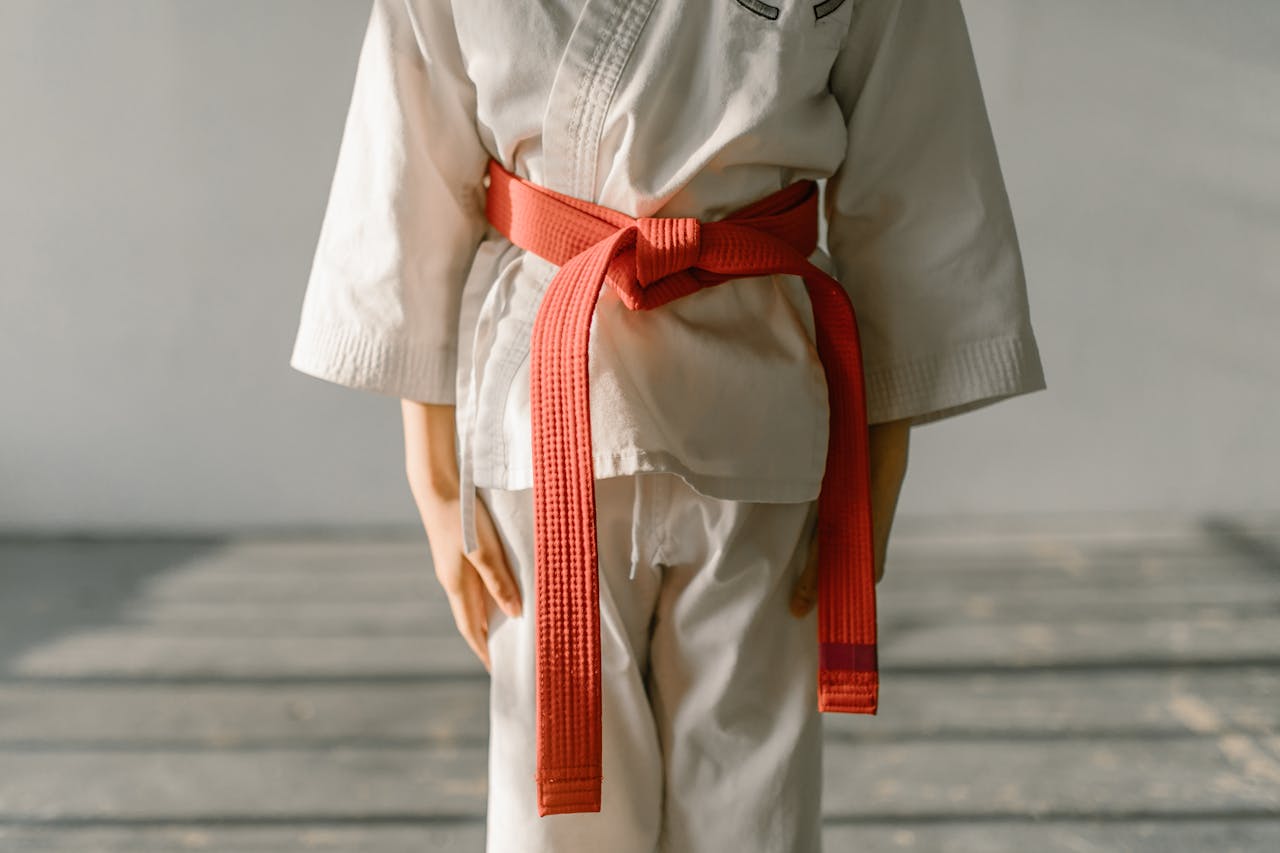
Your belt progression system is the backbone of student retention. It's not just about organizing your teaching content. It's about giving students a clear, visible answer to the question "where am I going?"
The research on this is clear: students who can see exactly what they're working toward and who get regular acknowledgment of progress stay enrolled significantly longer. Schools with structured rank systems and milestone recognition see average enrollment lengths of 24 to 36 months. Schools without them average closer to 11 to 14 months.
Design your rank structure with clear criteria
Define exactly what a student needs to demonstrate to advance from each belt to the next. Don't leave it vague. If a student needs to execute a specific combination with correct form, demonstrate a kata, or pass a sparring evaluation, write that down. Vague requirements frustrate students and create arguments with parents.
Space your ranks appropriately
Too many ranks in quick succession feels cheap. Too few makes the path feel impossible:
- Most youth karate and Taekwondo programs use 8 to 10 color belt ranks before black belt, spaced roughly 3 to 6 months apart for consistent students
- Adult BJJ traditionally uses 4 colored belts before black belt, each taking 1 to 3 years
Create milestones between formal tests
Belt promotions happen every few months, but students need feedback and recognition more frequently than that. Effective milestone tools include:
- Monthly progress updates shared with students and parents
- Attendance milestone patches
- Brief one-on-one feedback from the instructor
One school that introduced monthly progress updates for every student saw its average enrollment length grow from 11 months to 19 months without spending a dollar more on marketing.
Charge a testing fee
Belt tests should carry a fee ($30 to $75 is standard). This covers the cost of the new belt and certificate, creates a meaningful event around the promotion, and adds a legitimate revenue stream. Most families don't object when the testing process is rigorous and the achievement feels earned.
Step 6: Set Your Pricing Structure
Most martial arts schools charge in the $100 to $200 per month range for unlimited group classes, with the average falling around $120 to $150/month across the U.S. market. Your local competitive landscape and your cost structure should both influence where you land.
Monthly membership (unlimited classes) is the standard and most sustainable model. It creates predictable recurring revenue, commits students to attendance, and removes the friction of per-class payment.
Tiered membership is one of the most reliable ways to increase average revenue per student:
- Basic tier: group classes only
- Standard tier: group classes plus open mat time or access to extra sessions
- Elite tier: group classes plus private coaching
Schools that introduce tiered pricing typically see average revenue per student rise 20 to 35% within the first 90 days of implementation.

Additional revenue streams worth building in from the start:
- Private lessons: $50 to $100 per 30-minute session
- Belt testing fees: $30 to $75 per test
- Uniforms and gear: sold at retail markup (20 to 50%)
- Seminars and workshops with guest instructors: $50 to $150 per attendee
- Summer camps and holiday intensives: $150 to $400 per week
Don't underprice to fill classes quickly. It feels like a smart launch strategy, but it attracts price-sensitive students who leave when you raise rates, and it trains the market to expect low prices from your school. Price your membership at what it's worth and use a strong trial class experience to convert at that price.
Step 7: Get Your First Students Before You Open
The schools that fill quickly don't wait until opening day to start building an audience. They start 60 to 90 days before the doors open.
Build a waitlist
A simple landing page with your location, a photo or two of the training space, a brief description of your program, and an email capture form is enough. Share it in:
- Neighborhood Facebook groups and local parenting forums
- Kids' sports events and school fairs
Families actively looking for martial arts classes are not hard to find.
Run a launch intro class or open mat
Invite the people on your waitlist to a free or discounted first session before you officially open. This gives prospective students a real experience to evaluate rather than just a brochure to read. A well-run intro class converts at a high rate because the experience sells itself. Families who watch their child engage, get corrected, and leave with something to practice will almost always enroll.
Partner with local schools and pediatricians
Flyers in pediatric waiting rooms and school newsletters reach exactly the audience you want. A card that says "Build confidence and discipline: free trial class this month" costs almost nothing to distribute and reaches parents who are already thinking about after-school activities.

Ask for referrals from your first students
Your first 20 to 30 families are your best marketing asset if you give them a reason to talk about you:
- Acknowledge progress publicly in class
- Send personal notes when students hit milestones
- Create the kind of environment parents want to brag about to their friends
Step 8: Set Up Operations Before Your First Class
A martial arts school with 30 students and manual systems works. With 80 students, it starts to break. With 150, it breaks entirely. Setting up the right operational systems early saves you from the painful process of retrofitting everything while you're also trying to teach 20 classes a week.
What you need to configure before you open:
- Enrollment forms with waivers (e-signatures, guardian info, emergency contacts, medical notes)
- Payment processing and automated billing setup
- Class schedule and level structure in your management software
- Trial class booking flow so parents can self-book without calling you
- Follow-up communication for leads who haven't enrolled yet
Classcard, a martial arts school platform is built around the academy model that most dojos actually run: students in levels, progressing through terms, with parents tracking development through a branded app. It handles:
- Online registration with customizable enrollment forms
- Automated payment collection
- Attendance tracking
- Make-up class workflows
- Student progress tracking with customizable rubrics
- A parent-facing Progressive Web App that requires no app store download
The Starter plan runs $99/month. Business and Enterprise plans include a one-time setup fee that covers full onboarding and training. All plans come with a 7-day free trial.
For a deeper look at what running a dojo day-to-day involves, the Classcard martial arts school management guide covers retention, class structure, and scaling your program.
What to Expect in Year One
Most martial arts schools don't break even in their first six months, and that's normal. Enrollment takes time to build. If you start with 20 students paying $120/month, you're generating $2,400 against $6,000 to $8,000 in costs. You're running at a loss in the short term to build something with strong long-term recurring revenue.
The economics shift significantly once you pass 50 to 60 students. At 80 students paying $130/month average, you're generating $10,400/month, which is enough to cover costs, pay yourself a modest salary, and start investing back into marketing and facility improvements.
Set two milestones for your first year:
- Reach break-even enrollment by month 6
- Reach 1.5 times break-even by month 12
Track your student count, monthly revenue, and retention rate every single week. If enrollment isn't growing on track by month 3, address the marketing or conversion problem before it compounds.
Frequently Asked Questions
How much does it cost to start a martial arts school?
Starting a martial arts school typically costs between $15,000 and $80,000 depending on whether you lease a dedicated space or share an existing facility. The biggest variables are mat flooring and equipment ($5,000 to $20,000), build-out costs ($5,000 to $30,000), and your initial marketing and operating buffer. Sharing space with an existing gym or community center can bring startup costs under $10,000.
Do you need a certification or license to teach martial arts?
In the U.S., there is no federal or state-level teaching license required to operate a martial arts school. However, most established martial arts organizations require instructors to hold at minimum a 1st Degree Black Belt to teach. Aligning with a recognized governing body or association for your discipline gives you access to accredited rank certification for your students, which matters for belt legitimacy and parent confidence. First aid certification and background checks are worth requiring for all instructors regardless of rank.
How many students do I need to break even?
It depends on your cost structure and pricing. As a benchmark: if your monthly overhead is $7,000 and you charge $120/month per student, you need approximately 59 students to break even. Calculate your own break-even number before you open using your actual costs. It's the most important number in your business plan.
What is the best pricing model for a martial arts school?
Monthly membership with unlimited group classes is the most sustainable model for most schools, typically priced at $100 to $175/month depending on location and discipline. Tiered membership (basic, standard, elite) is the most effective way to increase average revenue per student without raising base prices. Separate fees for belt testing, private lessons, and uniforms add meaningful revenue on top of monthly tuition.
How do I retain students once they enroll?
The biggest dropout risk is months three to six, when students feel like they're not progressing. A clear belt progression system with defined criteria, combined with regular milestone recognition between formal tests, is the most effective retention tool available. Schools that give students monthly progress updates and visible acknowledgment of achievement see average enrollment lengths grow from around 11 months to 19 months or more. Retention is a systems problem as much as a teaching problem.
What software do martial arts schools use to manage enrollment and classes?
Most schools that grow past 50 students need dedicated class management software to handle enrollment, billing, attendance, make-up class scheduling, progress tracking, and parent communication. Platforms like Classcard are built around the academy model that dojos actually run, rather than the fitness membership model used by general gym software.
If you're ready to set up your enrollment and class management before your first session, try Classcard free for 7 days.