

If you coach recreational gymnastics, you already know the challenge: kids show up with wildly different energy levels, attention spans, and skill levels — and you need to keep all of them moving, learning, and having fun for the next 45-60 minutes.
The right gymnastics games solve multiple problems at once. They warm up muscles, reinforce fundamental skills, build strength and coordination, teach body awareness, and most importantly, make kids want to come back for the next class! When parents see their child running out of class saying "that was SO fun," they re-enroll. That's the connection between great class programming and student retention.
Here are 15 games that experienced gymnastics coaches swear by. They're organized by purpose — warm-up games, skill-building games, conditioning games, and cool-down games — so you can drop them into any class structure. Most require nothing more than the equipment you already have.
Warm-Up Games (Get Hearts Pumping)
The goal of a warm-up game is simple: get every kid moving, get their heart rate up, and get them mentally focused on class. A good warm-up game has zero downtime; nobody should be sitting out or standing still.
1. Earthquake, Volcano, UFO
Ages: 3-8
Time: 4-5 minutes
Equipment: None
Kids move around the gym using a locomotion you call out (skipping, galloping, bear walking, crab walking). When you shout a command, they react:
- Earthquake: Stop and shake on the spot
- Volcano: Run to one end of the gym ("escape the lava!")
- UFO: Drop down and cover their heads
Start with two commands and add more as kids learn them. You can customize this endlessly — add "Tightrope" (balance on a floor line), "Statue" (freeze in a gymnastics shape), or "Kangaroo" (tuck jumps on the spot). This game keeps everyone active the entire time, and the listening component gets their brains engaged from the start.
2. Skill Freeze Dance
Ages: 3-10
Time: 4-5 minutes
Equipment: Speaker/music
Play upbeat music and have kids move around the gym. When the music stops, call out a gymnastics shape (tuck, straddle, pike, star, front support, back support, or bridge). Kids must freeze in that shape and hold it until the music starts again.
This is a warm-up and a shapes assessment rolled into one. You can instantly see who knows their shapes and who needs more practice, without making it feel like a test.

3. Traffic Lights
Ages: 3-7
Time: 3-4 minutes
Equipment: None
Kids move around the gym responding to color commands:
- Green light: Run
- Yellow light: Walk slowly
- Red light: Freeze completely
Once they've got the basics, layer in gymnastics-specific commands: "Blue light" means bear walk, "Purple light" means crab walk, "Orange light" means bunny hops. The layering keeps older kids challenged while younger ones can stick with the basic three.
4. Star Tiggy (Stuck in the Mud)
Ages: 4-10
Time: 5-6 minutes
Equipment: None
A classic tag game with a gymnastics twist. Designate 2-4 taggers (depending on group size). When you're tagged, you freeze in a star shape (or front support, or straddle stand — vary it each round). You're "unstuck" when another player crawls through your legs (or rolls under your bridge, depending on the shape).
The key coaching detail: taggers cannot stand and wait next to a frozen player. This keeps the game moving and prevents bottlenecks. If a tagger is hovering, remind them to go find someone else.
Skill-Building Games (Learn While Playing)
These fun gymnastics games disguise skill practice as play. Kids don't realize they're drilling fundamentals, they just think they're having fun.
5. Coach Says
Ages: 4-10
Time: 6-8 minutes
Equipment: Mats
The gymnastics version of Simon Says. Line kids up on one side of the floor. Call out skills prefixed with "Coach Says" — forward roll, cartwheel, tuck jump, handstand against the wall, log roll. If you say a skill without "Coach Says" first and a gymnast does it, they go back to the starting line.
Adjust the skills to match the level. For preschoolers, keep it simple: shapes, jumps, and animal walks. For older recreational gymnasts, include cartwheels, handstands, bridges, and rolls. This game lets you assess skills, reinforce technique cues, and keep the energy high, all at once.
6. Skill Path Board Game
Ages: 5-12
Time: 10-15 minutes
Equipment: Whiteboard, magnets, foam dice, mats
Draw a winding path on a whiteboard (like a board game). Label each space with a skill — tuck jump, forward roll, cartwheel, 10-second handstand hold, bridge, straddle sit and reach, 5 push-ups. Use small magnets or stickers as game pieces.
Kids take turns rolling a foam dice and moving their piece along the path. They must successfully complete the skill they land on. If they can't complete it, they move back 2 spaces. First to finish wins.
This game is perfect for mixed-ability groups because you can put easier skills at the start of the path and harder ones near the end. Kids self-select their challenge level based on how far they get.
7. Balance Beam Bean Bag Toss
Ages: 5-10
Time: 5-8 minutes
Equipment: Balance beam (or floor line), bean bags
Two gymnasts start at opposite ends of the beam, each holding a bean bag. They toss the bean bag back and forth. After each successful catch, they each take one step backward (increasing the distance). If the bean bag drops or someone falls off the beam, they start over.
For younger kids, use a low beam or a floor line. For older kids, use a regular-height beam and add challenges: catch with one hand, toss under your leg, toss while standing on one foot.
This game builds balance, hand-eye coordination, and focus, all core gymnastics skills, without kids feeling like they're "practicing balance."

8. Obstacle Course Relay
Ages: 4-10
Time: 10-12 minutes
Equipment: Mats, blocks, hoops, bar (adapt to your gym)
Set up a simple obstacle course using equipment you already have: forward roll down a wedge mat, jump over a set of blocks, bear walk along a floor line, swing on the bar (or do a chin-up hold), jump into a hoop and hold a tuck shape for 3 seconds.
Split kids into teams. One gymnast goes at a time, relay-style. First team to get all members through the course wins. Rotate the course order or change specific stations each week to keep it fresh.
Relays are incredibly effective because the team element adds excitement and urgency, and the waiting time is short enough that kids stay engaged (unlike games where they sit out for long stretches).
9. Add-On
Ages: 5-12
Time: 8-10 minutes
Equipment: Mats
Line kids up. The first gymnast enters the floor and performs one skill (a tuck jump, for example). The second gymnast performs the first gymnast's skill and adds one of their own (tuck jump, then forward roll). The third gymnast does both and adds a third. Keep going until someone forgets the sequence or can't complete a skill, and then start a new round.
This game builds memory, sequencing, and confidence. Kids love watching the sequence get longer, and the ones waiting in line are actively engaged because they need to remember the order. It also gives you insight into which skills kids choose when given freedom. They'll naturally gravitate toward what they're comfortable with, which tells you what to work on.
Conditioning Games (Build Strength Without the Groans)
Conditioning is essential for gymnastics progression, but telling a 6-year-old to "do 10 push-ups" doesn't exactly spark joy. These gymnastics games for kids build strength and endurance while keeping them engaged.
10. Builders and Destroyers
Ages: 3-8
Time: 5-6 minutes (2-3 rounds)
Equipment: Foam blocks or soft cones
Scatter foam blocks or soft cones around the gym, some standing upright and some knocked over. Split kids into two teams: Builders and Destroyers. Builders try to stand all the blocks upright. Destroyers try to knock them all over. Play for 60-90 seconds, then count.
- Most blocks standing = Builders win
- Most knocked over = Destroyers win
Here's where the conditioning comes in: kids must use a squat to set blocks upright and a squat or lunge to knock them over. They're doing dozens of squats and lunges without realizing it. Switch team roles each round.
11. Wheelbarrow Push-Up Race
Ages: 5-12
Time: 5-6 minutes
Equipment: Cones or floor markers
Kids pair up. One partner holds the other's ankles in wheelbarrow position. The "wheelbarrow" walks on their hands toward a line or cone. At random intervals, the holder calls out "Push-up!" and the wheelbarrow does one push-up before continuing.
Set a short distance (5-8 meters) so kids can complete it. Partners switch roles for the next round. You can turn this into a race between pairs, or just focus on completing the distance.
This builds serious upper body and core strength, the exact muscles that young gymnasts need for handstands, cartwheels, and bar work, disguised as a silly and fun partner game!
12. Dice Conditioning
Ages: 5-12
Time: 6-8 minutes
Equipment: Foam dice, whiteboard
Make or buy a large foam dice (or write numbers on a soft cube). Create a list of six exercises on a whiteboard, for example, 1 = tuck jumps, 2 = push-ups, 3 = V-ups, 4 = squat jumps, 5 = plank hold (seconds), 6 = bridge hold (seconds).
Kids take turns rolling the dice. Whatever number comes up, everyone does that exercise. The gymnast who rolled picks how many reps (within a range you set, say 5-10). This gives kids a sense of control and ownership, which dramatically increases buy-in compared to coach-directed conditioning.
13. The Floor Is Lava
Ages: 4-10
Time: 8-10 minutes
Equipment: Mats, blocks, beams, any available equipment
Place mats, beams, blocks, and other equipment around the gym with gaps between them. The floor between equipment is "lava." Kids must travel from one end of the gym to the other using only the equipment — jumping, climbing, balancing, and swinging without touching the floor.
If they touch the floor, they go back to the last piece of equipment they were on and try again. You can make this collaborative (the whole group works together to get everyone across) or competitive (first one across wins).
This builds jumping confidence, spatial awareness, grip strength, and problem-solving, and trust us, it's one of those gymnastics activities that kids will literally beg to do again!

Cool-Down Games (Wind Down Without Losing Them)
The last few minutes of class matter more than most coaches realize. A chaotic ending means kids leave overstimulated and parents pick up a wound-up child. A calm, fun ending means kids leave happy and parents leave impressed.
14. Sleeping Gymnasts
Ages: 3-8
Time: 3-4 minutes
Equipment: Bean bags or small soft toys
Kids lie on their backs on mats with eyes closed, as still as possible. The coach walks around and gently places a small bean bag or soft toy on each gymnast's stomach. If the bean bag falls off (because they're moving or giggling), they're "out" and sit quietly on the side.
The last gymnast still lying still with their bean bag balanced wins. This game naturally brings heart rates down, practices body control and stillness, and gives you 3-4 minutes of blissful quiet at the end of a high-energy class. Parents watching from the viewing area will be genuinely impressed at how calm their child becomes.
15. Shape Show-Off Circle
Ages: 3-10
Time: 3-5 minutes
Equipment: None
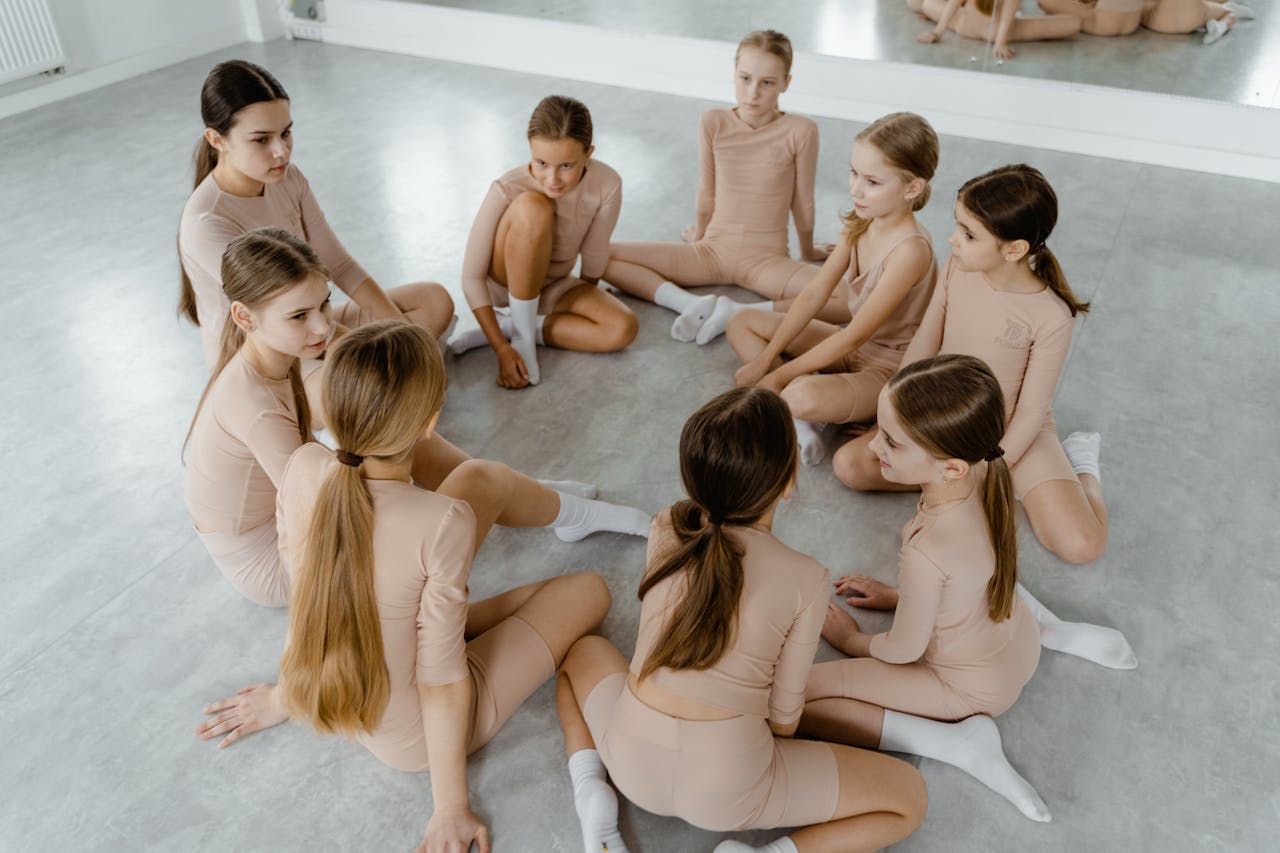
Kids sit in a circle. Go around the circle and each gymnast gets 10 seconds to show their best gymnastics shape or skill. The rest of the group claps after each one. No competition, no judging. Just a chance for every child to be seen and celebrated.
This works beautifully as a class closer because it ends on a positive, confidence-building note. Every child, even the one who struggled through class, gets a moment of recognition. Parents watching see their child perform with pride. It takes 3-5 minutes depending on class size and builds the kind of supportive class culture that keeps families enrolled long-term.
Making Games Work: Coaching Tips
Great games poorly coached fall flat. Here are a few principles that make the difference:
- Explain in 30 seconds or less: If you can't explain a game in under 30 seconds, it's too complicated for the age group. Where possible, demonstrate rather than explain. Kids learn by watching, not listening.
- No permanent "outs": Games where kids get eliminated and sit on the sideline are terrible for engagement and terrible for warm-ups (they can't get warm while sitting). If a game has an "out" mechanic, make it temporary, for instance, do 5 jumping jacks and rejoin.
- Rotate games on a 3-4 week cycle: Kids love familiarity, but they also get bored fairly quickly. Introduce a new game every few weeks and keep a rotation of 5-6 favorites that you cycle through. When a game starts losing its magic, shelve it for a month and bring it back.
- Match games to the class goal: If the next part of class is bar work, use a warm-up that activates upper body (wheelbarrow walks, bear crawls). If you're working on balance, use a game with freezing and shape-holding. Intentional game selection makes the transition into skill work seamless.
- Watch for the kids on the edges: In every class, there are 1-2 kids who hang back during games. They could betoo shy, too overwhelmed, or just unsure of the rules. Pair them with a confident partner, give them a specific role (like "you be the first builder"), or simply stand near them and play alongside them for the first round.
How Games Connect to Retention
Here's the business case for investing time in your game programming: kids who enjoy class stay enrolled. Parents who see their child excited about gymnastics re-enroll for the next term without being asked.
The gyms that have the strongest retention don't necessarily have the best equipment or the most qualified coaches. They have classes where kids feel successful, included, and excited, and thoughtful gymnastics game selection is one of the most effective tools for creating that experience.
If you're looking for a way to track which games and class structures lead to the best attendance and retention patterns, a class management platform can help. Classcard lets you track attendance across classes and terms, so you can see which programming keeps kids coming back, and where drop-off happens.
Want to track which class formats drive the best attendance and retention at your gym? Schedule a free demo or try Classcard free for 7 days — built for gymnastics programs, with scheduling, attendance tracking, and parent communication in one place.
Frequently Asked Questions
1. What are good warm-up games for gymnastics?
The best warm-up games keep every child active with zero downtime. Games like Earthquake/Volcano/UFO, Skill Freeze Dance, Star Tiggy, and Traffic Lights get heart rates up while reinforcing gymnastics shapes and movements. Avoid any warm-up game where kids get "out" and sit on the sideline.
2. How do I make gymnastics conditioning fun for kids?
Turn conditioning into games. Builders and Destroyers disguises squats as a team competition. Wheelbarrow Push-Up Race builds upper body strength through partner play. Dice Conditioning gives kids ownership by letting them roll for exercises. The key is that kids should be doing the work without feeling like they're doing the work.
3. What gymnastics games work for mixed-age groups?
Games with layered complexity work best for mixed ages. Traffic Lights can be played with 3 commands for younger kids and 7 for older kids simultaneously. Obstacle Course Relays let you adjust station difficulty by group. Add-On naturally scales because each child chooses skills they're comfortable with. Coach Says lets you call age-appropriate skills for different groups in the same game.
4. How long should games last in a gymnastics class?
Warm-up games should last 3-6 minutes, long enough to raise heart rates, short enough to leave time for skill work. Skill-building games can run 8-15 minutes. Conditioning games work best in 5-8 minute bursts. Cool-down games should be 3-5 minutes. In a 60-minute class, games typically make up 15-25 minutes total, with the rest dedicated to structured skill instruction.
5. How do I keep parents happy with games in class?
Parents want to see their child learning gymnastics skills, not "just playing games." The trick is choosing games that visibly develop gymnastics skills — shapes, strength, balance, coordination — so parents can see the purpose. Shape Show-Off Circle at the end of class lets every child demonstrate what they've learned, giving parents a tangible takeaway every week.