

The first five minutes of any kids class sets the tone for everything that follows. A distracted group that shuffles in mid-conversation and takes forever to settle is a recurring challenge for studio and academy owners across every discipline. A well-designed warm-up cuts through that noise immediately.
Why Warm-Ups Matter More Than You Think
Beyond energy management, warm-ups serve a genuine physical purpose. They raise core body temperature, increase blood flow to working muscles, and prepare joints for load. For kids especially, skipping this step raises injury risk. A child who moves straight into a cartwheel, a jab-cross combination, or a breaststroke set without preparation is a child whose body is not ready for that demand.
There is also a psychological dimension that is easy to overlook. A fun, structured warm-up signals to kids that class has started and something good is happening. It reduces the anxiety some children feel at the beginning of a session, creates early wins (especially important for shy or new students), and builds the kind of group cohesion that keeps kids coming back week after week.
For studio and academy owners, warm-ups are also a quiet retention tool. Classes that feel energetic and well-organised from the first minute are classes that parents and children talk about. If you are thinking seriously about how to retain students at your studio or academy, the quality of your warm-up routine is one of the easiest things to improve right now.
The 20 activities below are split into four categories: movement-based, music and rhythm, games and challenges, and creativity and imagination. Most require no equipment and work across multiple disciplines.
Movement-Based Warm-Ups
These get the body moving quickly and are easy for coaches and instructors to lead from the front.
1. Animal Walks
Call out an animal and kids must move across the space in that style. Bear crawls (hands and feet, hips high), crab walks (seated, hands and feet, belly up), frog jumps, bunny hops, elephant stomps, snake slithers. Rotate every 15 to 20 seconds. This works the whole body without kids realising they are doing conditioning, and it is genuinely entertaining to watch a room full of young gymnasts doing their best penguin impression.
Animal walks are particularly effective for gymnastics and dance studios, where floor-based movement patterns appear throughout class anyway. You can easily tailor the animals to mirror movements students will encounter later in the session.
2. Mirror Me
Students pair up. One leads and one mirrors every movement in real time. After 60 seconds, switch. This builds spatial awareness, reaction time, and focus. It is especially good for martial arts warm-ups because it develops the habit of reading an opponent's body. For younger kids, an instructor-led version where the whole class mirrors the teacher works just as well.
3. Traffic Light Freeze
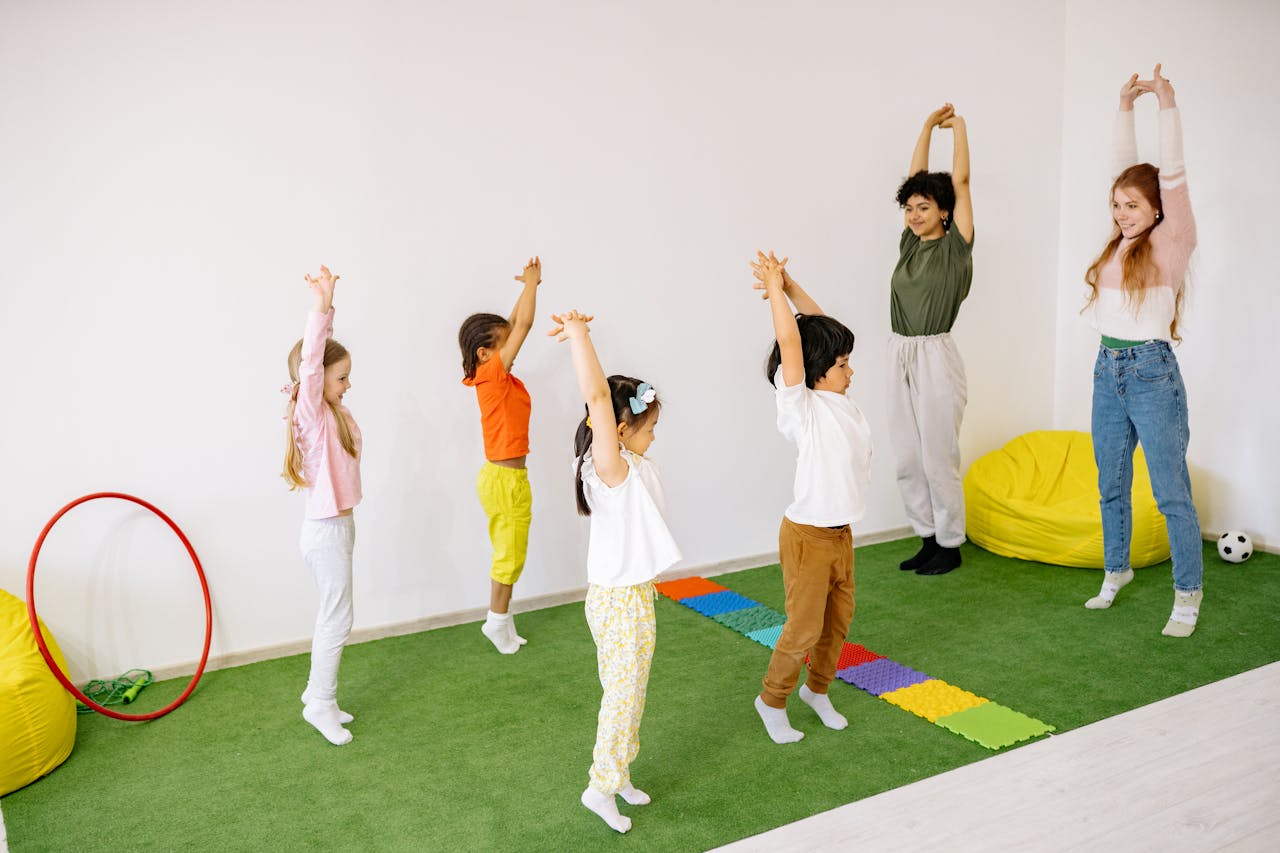
Simple and universal. When you call green, kids jog or move freely. Yellow means slow motion. Red means freeze completely. Add complexity as you go: freeze in a balance position on one leg, freeze in a lunge, freeze in a push-up hold. This is a reliable standby for swim schools doing land drills before entering the pool, and it burns off early-class energy fast.
4. Simon Says (Movement Edition)
The classic game, upgraded with discipline-specific movements. For dance: "Simon says do a plié." For martial arts: "Simon says take a guard stance." For gymnastics: "Simon says hold a tuck position." The focus required to listen for the "Simon says" cue means kids are genuinely paying attention, which makes the transition into structured learning smoother.

5. Shark Attack
Mark out a safe zone at one end of the space. One or two students are "sharks" and must tag the others as they attempt to cross. Anyone tagged joins the sharks. Last student standing wins. The short sprint bursts and direction changes here are excellent cardiovascular preparation, and the competitive edge keeps even the most reluctant movers engaged. A strong warm-up game for football academies and sports classes where speed and agility are part of the curriculum.
6. Blob Tag
One student starts as "it." When they tag someone, that person joins hands and becomes part of the blob. The blob grows with each tag until everyone has been caught. This encourages teamwork (the blob has to coordinate), builds spatial awareness, and creates genuine laughter. It works for any age group and requires no equipment.
7. Follow the Leader Relay
Students line up in single file behind the instructor. The leader performs a movement sequence (skip, jump, turn, balance) and everyone copies. After one lap of the space, the leader moves to the back and the next student in line takes over. This builds confidence in children who might be hesitant to stand out, because the role of leader rotates to everyone equally.

Music and Rhythm Warm-Ups
These work especially well for dance, music school, and any class where rhythm and timing are part of the core curriculum.
8. Freeze Dance
Play music and let kids dance freely. When the music stops, everyone freezes. Simple, joyful, and extraordinarily effective for burning off the frantic energy of younger age groups. Add a challenge layer: freeze on one leg, freeze in your best superhero pose, freeze at the lowest level you can manage. The unpredictability of when the music stops keeps attention locked in.
9. Rhythm Circle
Students sit or stand in a circle. The instructor claps a short rhythm pattern and students echo it back in unison. Gradually increase the length and complexity of the patterns. This warm-up is a staple for music schools but transfers surprisingly well to martial arts (where rhythm underpins combination timing) and dance. It also requires complete attention, which settles a restless group quickly.
10. Musical Statues with a Twist
A variation on freeze dance. When the music stops, call out a shape or position students must hold (a star, a letter of the alphabet, a number, an animal). Students who move or can't hold the position sit out and become judges who spot anyone who wobbles. Kids who are "out" stay engaged rather than drifting to the edges.
11. Name and Move
Students stand in a circle. Each child says their name and performs a movement. The rest of the group repeats the name and the movement. This is a brilliant first-week activity for new groups and a good check-in exercise when you have new starters joining mid-term. It builds group familiarity and requires just enough physical coordination to serve as a genuine warm-up.
12. Drum Beat Marching
With a drumbeat (or clapping, or a beat on a wall), students march, jog, or move in time. Speed up the beat; slow it down. Students must adjust instantly. This develops listening skills and temporal coordination. For swim schools with a separate dryland warm-up space, this can be a useful transition activity before students move to the pool deck.
Games and Challenges
Slightly higher intensity than movement activities, these tend to produce a lot of noise and energy in the best possible way.
13. Hula Hoop Relay
Set up hoops across the floor. Students step in and out of each one in sequence, as quickly as they can, before running back and tagging the next person. Vary the footwork pattern (two feet, one foot, alternate feet) to adjust difficulty. Hoops are inexpensive and multi-purpose; they can be repurposed for agility drills, boundary markers, and gymnastics floor exercises. For a practical look at how game-based activities improve engagement in specific disciplines, the fun gymnastics games for kids guide is worth a read.

14. Rock, Paper, Scissors Tag
Students wander the space and pair up randomly for a game of rock, paper, scissors. The winner chases the loser to a safe zone at one end of the room. Then both find new partners. The randomness of pairings and the constant movement between games makes this a surprisingly effective cardiovascular warm-up. It also breaks social cliques in a low-pressure way, which is useful early in a new term.
15. Four Corners
Number the four corners of the space 1 to 4. One student stands in the middle with eyes closed and counts to 10. Everyone else quietly moves to a corner. The counter calls a number; everyone in that corner is out. Repeat until one student remains. This involves short bursts of movement and strategic thinking, with a low-pressure elimination structure that most kids handle well.
16. Jump the River
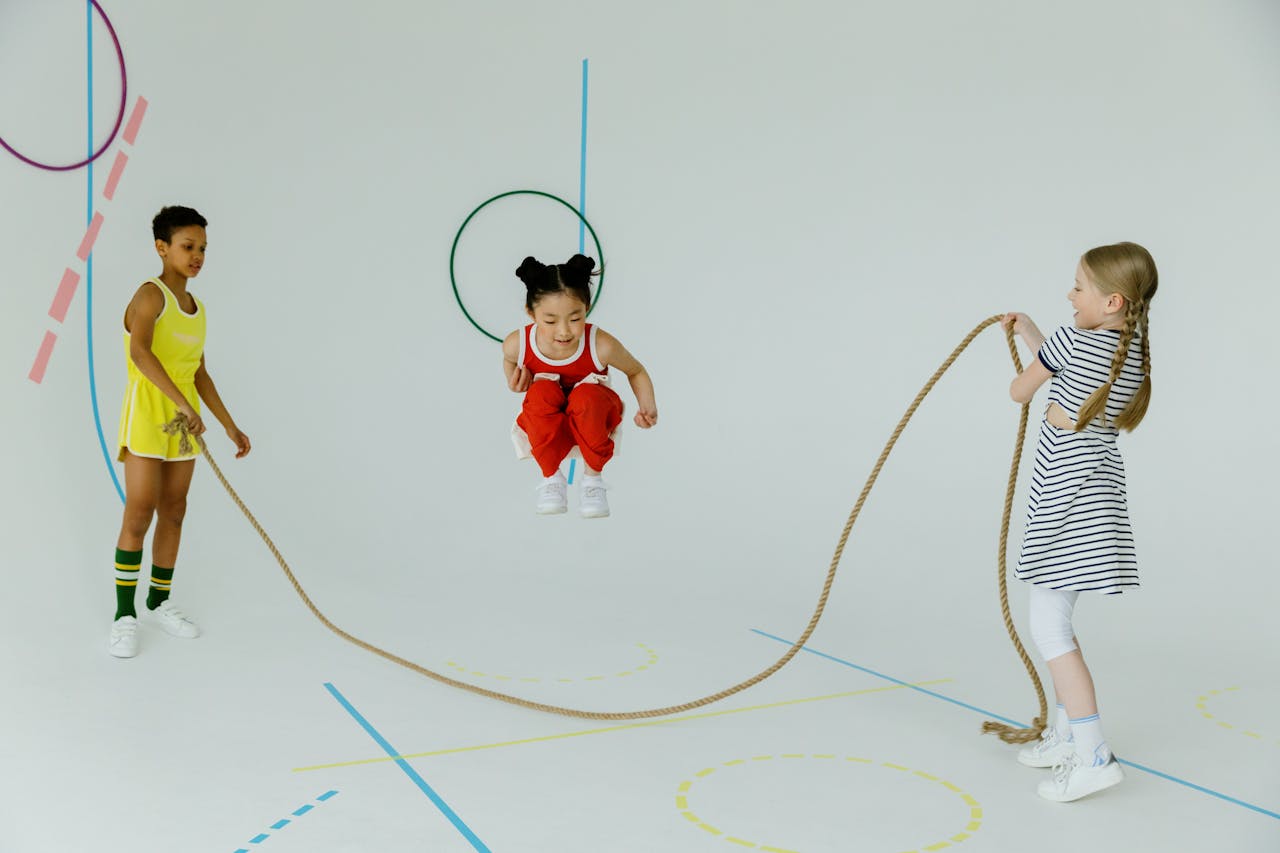
Lay two parallel lines on the floor using tape or cones (the "river"). Students take turns jumping across. Start narrow and gradually widen the gap between the lines each round. This is straightforward, requires no technical instruction, and has a clear progressive structure kids find satisfying. For gymnastics and dance studios, it builds the explosive power that underpins jumps and leaps later in class.
17. The Floor Is Lava
Mark out "safe zones" around the space using mats, hoops, or cones. When you call "the floor is lava," everyone must get to a safe zone within three seconds. Reduce the number of safe zones progressively. The urgency of the game produces fast, sharp movements, and the imaginative premise captures younger students completely. After the warm-up, the instruction "okay, the floor is safe again, let's line up" lands surprisingly well.
Creativity and Imagination Warm-Ups
These build engagement through storytelling and open-ended movement, particularly effective with younger age groups.
18. Superhero Training Camp
Tell students they have been selected for superhero training camp. Walk them through a sequence of movements in character: "Sprint to the end of the room! A villain is escaping! Now freeze, you've used your powers and you're recharging." This kind of narrative warm-up holds attention through imagination rather than instruction, which reduces resistance in reluctant movers. Even children who would normally hang back during a standard jog tend to sprint when there is a villain to chase.
19. Shape Shifters
Call out shapes and students must form them with their bodies, either individually or in pairs and groups. A star, a triangle, the letter T, a circle. For group shapes, kids have to communicate and cooperate quickly to arrange themselves in time. This is a particularly strong warm-up for any discipline that involves formations or group choreography, including dance and gymnastics floor routines.
20. Story Movement
Begin narrating a short story and students act out every element physically. "You're walking through a deep forest (slow, exaggerated steps). Suddenly you hear something, freeze! A giant bird swoops past, duck! Now you're running through the trees, go!" The instructor controls the pace and intensity of the warm-up through the story, which makes this one of the most versatile activities on the list. It works with age groups from four to twelve and can be as calm or as energetic as the session needs.

How to Choose the Right Warm-Up for Your Class
The activity that works brilliantly on a Tuesday evening with a group of confident twelve-year-olds might completely fall flat on a Saturday morning with a new intake of five-year-olds. A few principles help narrow the choice.
- Match energy to age. Younger children (4 to 7) respond best to imagination-based activities with simple rules. Older children (10 to 14) respond better to challenge and mild competition.
- Match the warm-up to what comes next. If the session involves a lot of floor work, lead into it with floor-based movement activities. If the lesson is heavily rhythm-based, a rhythm circle makes more sense than Shark Attack.
- Read the room on arrival. If students come in already hyper, channel the energy with something structured. If they arrive flat (early morning, cold day, tired group), you need something fun and slightly silly to lift the room before you can teach effectively.
- Rotate regularly. Doing the same warm-up every class produces familiarity that can quickly slide into indifference. Keep a rotation of six to eight activities and revisit each one on a cycle of every two to three weeks.
- Note what lands. After a session, spend 30 seconds noting which warm-up you used and whether it worked. Over a term, you will have a reliable picture of what your specific group responds to.

A great warm-up is not an afterthought. It is the opening act that determines how engaged, how responsive, and how physically prepared your students are for the lesson that follows. The 20 activities in this guide give you a range of options across energy levels, age groups, and disciplines, so you can always walk into class with something ready.
For studio and academy owners managing multiple classes and instructors, the real challenge is consistency. When you have three coaches running parallel sessions, it matters that all of them have access to the same resources and that the quality of each class, opening warm-up included, is something you can trust.
That is where the right class management platform makes a real difference. Classcard helps activity-based businesses organise everything behind the scenes, from scheduling and attendance to parent communication and billing, so that instructors can focus on actually teaching. If you want to see how it works for your studio or academy, book a free demo or explore Classcard free for 7 days.
Frequently Asked Questions
How long should a warm-up be for kids classes?
Most children's classes benefit from a warm-up of five to ten minutes. Shorter classes (30 to 45 minutes) should keep it to five minutes to preserve teaching time. Longer classes of 60 minutes or more can extend to ten minutes, particularly if the session involves high-intensity physical work.
Do I need equipment for kids warm-up activities?
Most of the activities in this guide require no equipment at all. A few (like Hula Hoop Relay or Jump the River) use simple, low-cost items like hoops, cones, or tape. The best warm-up activities tend to be the simplest ones, because they are easier to explain, start quickly, and involve everyone immediately.
How often should I change my warm-up routine?
Every two to three weeks is a reasonable rotation cycle. Repeating the same activity too frequently leads to disengagement, but some repetition is fine because familiar activities are easier to get started quickly. Keep a small bank of six to eight options and cycle through them.
Can I use these warm-ups for mixed age groups?
Yes, most activities here scale across age ranges. For mixed groups, choose activities with adjustable difficulty: Mirror Me, Simon Says, and Story Movement all work well because you can vary the complexity of instructions based on who is in the room.
What should I do if kids are not engaging with the warm-up?
Switch activities immediately rather than persisting with something that is not working. Having two or three options in your back pocket at the start of each session means you are never stuck. If low engagement is a recurring pattern, it is worth looking at whether the activity is age-appropriate and whether the group dynamic has changed (new students, end-of-term fatigue, and so on).