

Gymnastics is one of the few youth activities that parents sign up for twice: once for the fitness and confidence, and again when they watch their child land a first cartwheel and ask for another class. A child can start in a parent-and-tot session and stay through their teens, and families tend to stay with a gym that feels safe, well-coached, and clearly organized. That loyalty makes a well-run gymnastics academy one of the more predictable businesses in the activity space.
It is also one of the most capital-intensive and safety-sensitive. You need tall, open space, specialized equipment, qualified coaches, insurance that covers a high-risk activity, and a system that can handle levels, class ratios, and hundreds of weekly check-ins. This guide on how to start a gymnastics academy walks through every decision point, from choosing your model to your first 12 months of operation, so you can open with a plan instead of a guess.
Step 1: Choose Your Academy Model
Your model shapes your space, equipment, staffing, and pricing, so decide it first. Most new gymnastics academies start with recreational and preschool classes and add other programs once enrollment is stable.
Recreational and preschool programs
Recreational classes for children roughly ages 3 to 12 are the volume base of most gymnastics businesses. They run weekly, are organized by age and skill level, and generate the most reliable monthly enrollment. Preschool and parent-and-tot classes are a strong entry point because they need less specialized equipment and bring families into your gym early, often for years.
Competitive team programs
Competitive programs prepare athletes for meets, usually through USA Gymnastics (USAG) levels in the United States. They involve more training hours per week, higher tuition, and meet and travel costs, and they need coaches with deeper technical credentials. Teams build culture and pride, but they are coach-intensive and rarely the right place to start.
Tumbling, trampoline, and acro
Tumbling and trampoline programs need less apparatus than full artistic gymnastics and appeal to students who want tricks, cheer skills, or a competitive pathway outside traditional events. Acro is another option that works well in smaller spaces.
Add-ons: parties, camps, and open gyms
Birthday parties, school-break camps, open gym sessions, and parents' night out events add revenue on top of weekly classes and introduce new families to your gym. Camps in particular double as an enrollment funnel, which we cover in our guide to summer camp registration.
Which model should you start with?
Most successful academies launch with recreational and preschool classes, add parties and camps in the first year, and introduce a team program once the recreational base is stable. A team launched too early can strain your coaches and space before the revenue is there to support it.

Step 2: Write a Business Plan and Understand the Costs
Anyone learning how to start a gymnastics business needs a plan first. A gymnastics business plan doesn't need to be long, but it must answer two questions honestly: how will the academy make money, and what will it cost to operate before it does? Gymnastics has higher startup costs than most activity businesses because of the equipment and building requirements, so this is the step where many aspiring owners either underestimate the numbers or get overwhelmed. The reality sits in between.
What your plan should cover
- Target market: Which ages and programs will you serve, and how many families live within a 15 to 20 minute drive?
- Competitor review: Who else teaches gymnastics, cheer, or tumbling nearby, and how are they priced?
- Revenue model: Monthly tuition, terms, class packs, parties, camps, or a mix.
- Startup budget and monthly costs: Detailed below.
- 12-month projections: Conservative enrollment targets and a break-even point.
One-time startup costs
How much does it cost to open a gymnastics gym? The ranges below are planning estimates and vary widely by market, so get local quotes before you commit.
- Equipment: Industry guides such as ClimbTheLadder and ExercisePick put a full equipment package at $50,000 to $200,000 or more, depending on your focus. A full-size competition spring floor alone can cost around $20,000. Mixing new and high-quality used apparatus is a common way to manage the budget without compromising safety.
- Preschool and developmental equipment: Soft-play shapes, low beams, mini trampolines, and mats for young children typically add a few thousand dollars.
- Lease deposit and first month's rent: Varies widely with location and square footage.
- Build-out and improvements: Flooring, wall padding, ventilation, restrooms, a viewing area, and a front desk.
- Insurance, legal, and licensing: Business formation, general liability coverage, and local permits.
- Branding, website, and launch marketing: A clean website with your schedule, pricing, and registration is the minimum.
- Software: Registration, billing, attendance, and communication tools.
Realistic total: $30,000 to $500,000+
A lean launch, such as a preschool and recreational program in a smaller space with limited or used equipment, can open for roughly $30,000 to $100,000. A full recreational-plus-team facility with a new equipment package typically falls between $150,000 and $500,000 or more. ExercisePick's full-facility range runs from $100,000 to $750,000 or more. Plan a cash reserve covering at least six months of operating costs, since enrollment takes time to build.
Monthly operating costs
- Rent: Usually your largest fixed cost.
- Coaching payroll: Often your largest variable cost. A common planning benchmark is 35 to 50 percent of tuition revenue.
- Utilities: Heating, cooling, water, and internet for a large building.
- Insurance: Gymnastics policies cost more than those for low-risk activities.
- Equipment maintenance and replacement: Inspections, repairs, mats, and chalk.
- Software: From around $100 per month for most small academies.
- Marketing: Typically 5 to 10 percent of revenue in the early months.
- Governing body fees, if applicable: Covered in Step 3 below.

Step 3: Handle the Legal and Safety Foundations
To open a gymnastics academy you need a registered business, local approvals, insurance that covers gymnastics instruction, signed waivers, and written safety policies. It isn't the exciting part, but a gymnastics academy carries more inherent risk than most youth programs, so this needs to be in place before your first class.
Business structure and licenses
Register your academy as an LLC or the equivalent in your country before you take your first enrollment. You will typically also need a general business license, a zoning confirmation that your space can be used as a gymnastics facility, and a fire and occupancy inspection. Zoning matters more than most owners expect, because large open buildings often sit in commercial or industrial zones with specific use rules. Confirm this before signing a lease.
Insurance
Carry general liability insurance that explicitly covers gymnastics instruction, and add workers' compensation if you have employees. Many landlords require proof of coverage before a lease is signed.
Membership with a governing body
No law requires recreational gymnastics programs to join a governing body, but membership with your national or regional federation is usually the pathway if you plan to run a competitive team and enter sanctioned meets, and it signals credibility to many parents. Requirements differ by country, but they usually follow this pattern:
- The owner or managing director first needs an individual membership with the governing body.
- Register the academy as a member club and pay the annual club fee, which renews each season.
- Carry general liability insurance that meets the governing body's requirements, and be ready to show proof of coverage when you register.
- Make sure adult staff complete the required safeguarding or safety training and background checks.
- Name a safety contact who acts as the academy's liaison with the governing body on safety matters.
In the United States, for example, USA Gymnastics requires the owner to hold an individual membership first, then a Member Club membership ($275 for 2026-2027). Fees and requirements change each season, so confirm current details on the USA Gymnastics membership page before you budget. If you are outside the United States, check your national or local federation instead.
Waivers, policies, and emergency planning
- Liability waiver: Every student's parent or guardian signs one before the first class. Have a local attorney review it so it reflects the inherent risks of gymnastics.
- Safety policies: Written rules for spotting, apparatus use, equipment inspections, and supervision of non-class areas.
- Emergency action plan: Clear steps for injuries, including who calls emergency services, who stays with the athlete, and how parents are notified.
- Participant welfare policy: A written code of conduct for coaches and staff, including boundaries and how concerns are reported.
- Business policies: Cancellations, refunds, make-up classes, late pick-up, and dress code, all in writing and shared before enrollment.
.jpg)
Step 4: Find and Set Up Your Space
A recreational and preschool academy can start in roughly 3,000 to 5,000 square feet, while a full competitive gym often needs 10,000 square feet or more. Knowing how to open a gymnastics gym starts with the building, and space is the most unusual constraint in this business, because gymnastics needs ceiling height, open floor area, and a floor that can handle landings.
What to look for in a building
A suitable building has high ceilings, a large open floor plan with few or no support columns, solid flooring, and enough room for a waiting area, restrooms, and storage. The clear height you need depends on your apparatus and programs, so confirm requirements with your equipment supplier before you sign a lease. Easy parking and a smooth drop-off flow matter too, since parents arrive and leave in waves.
Lease tips
- Negotiate a build-out period with free or reduced rent while you set up equipment.
- Look for a multi-year lease with predictable annual increases.
- Ask about the landlord's rules on signage, noise, and floor loading.
Starting without your own building
If a full facility is out of reach at the start, there are lower-cost routes. Rent time in an existing gym or sports center, use a community hall or recreation center for preschool classes, or launch mobile programs with portable equipment. Renting reduces risk, though you give up control over scheduling and the environment. Our guide to class scheduling best practices can help you build a stable timetable around limited hours.
Equipment priorities
Start with the equipment your first programs need, not a full competition setup. For recreational and preschool classes that usually means a spring or carpeted floor, panel mats and landing mats, balance beams at several heights, a vault runway and springboard, a set of bars suited to beginners, trampolines, and soft-play shapes for little ones. Add pits, additional apparatus, and competition-level equipment as your team program grows. Buy from reputable suppliers, keep inspection records, and replace worn equipment promptly.
Step 5: Hire and Certify Your Coaching Team
Hire coaches who hold current first aid and CPR certification, pass a background check, complete safety training, and, for competitive levels, hold recognized technical credentials. Parents can tell within one class whether coaches are confident, kind, and safe, so your coaching team is the product.
Credentials to look for
Certification requirements vary by country and program type. In the United States, USA Gymnastics offers professional membership and coursework such as Fundamentals of Gymnastics Instruction (U100) and Safety and Risk Management (U101), alongside the required SafeSport training. Verify every credential before a coach works with students.
Background checks and child safety
Background checks are essential for every adult who works with minors. Pair screening with a written participant welfare policy, observable class areas, and clear rules for one-on-one contact.
Contractor vs. employee
Many new academies start with part-time or contracted coaches paid per class or per hour, and move to employees as schedules fill. Check your local rules on worker classification, since misclassifying employees as contractors is a common and costly mistake.
Class ratios
Smaller groups mean safer classes and happier parents. Preschool classes typically need the lowest ratios, and beginner recreational classes run higher ratios than advanced groups. Set ratios by age and skill, write them into your policies, and keep to them even when a class is popular. When a class is full, use a waitlist instead of adding students beyond the ratio.
Protect your student relationships
Build loyalty to the academy, not just to one coach. Make sure families know your gym's name and brand, keep enrollment agreements with the academy, and rotate coaches across groups where practical so no single departure takes a whole class with it.
Step 6: Build Your Curriculum and Level System
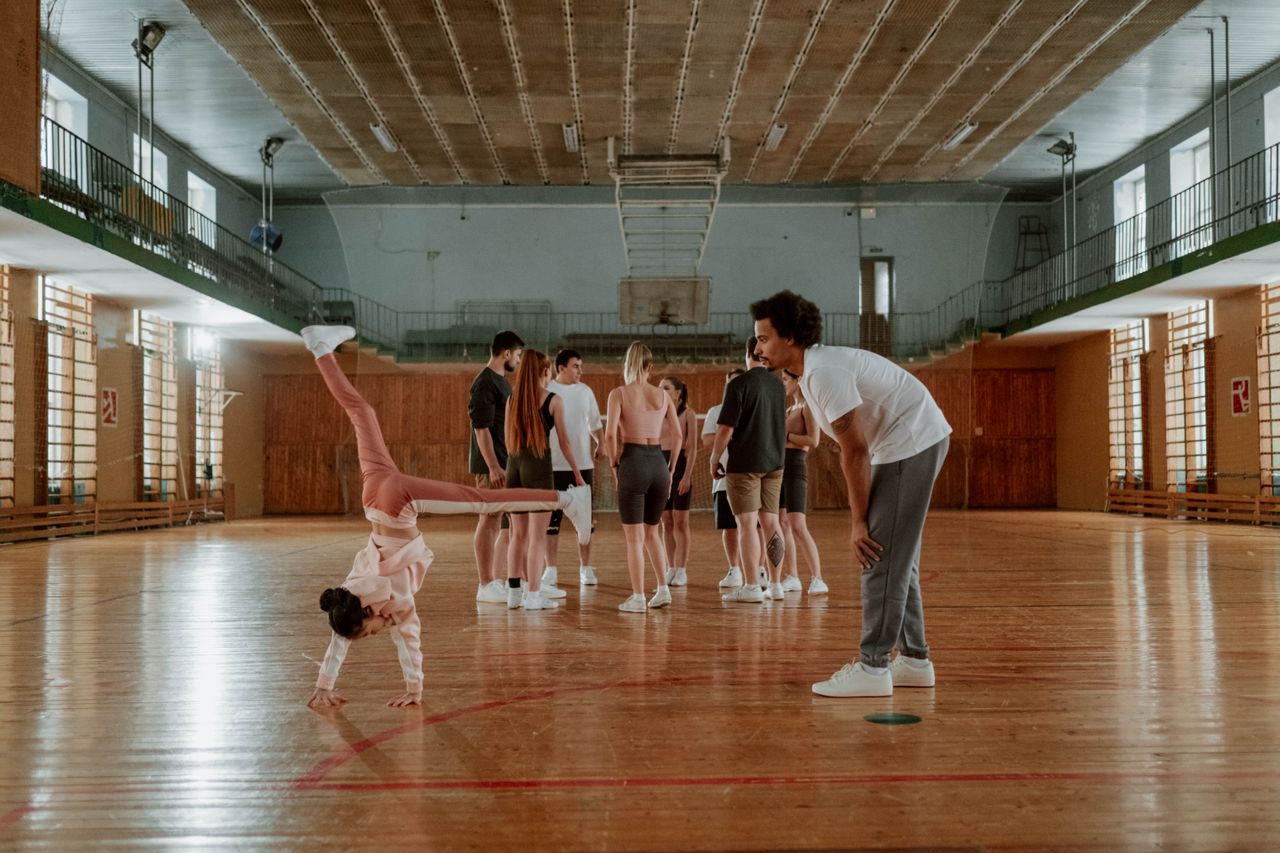
A clear level system turns a room full of mats into a program that families trust. Build your curriculum around skill-based levels rather than age alone, with written skills a student must show to move up.
Create skill-based levels
A typical recreational ladder runs from parent-and-tot to preschool, beginner, intermediate, advanced, and pre-team. Define the skills at each stage, such as a straight-body forward roll, a bridge kick-over, a stuck landing from a low beam dismount, or a supported cast on bars.
Use a recognized framework for team programs
Competitive programs run more smoothly when they follow a recognized framework from your national or regional governing body, so athletes and parents have a clear path to follow. If you run a competitive team in the United States, USAG's Junior Olympic levels give your athletes a clear progression and give parents an external reference point instead of a proprietary system.
Make progress visible
Gymnastics progress is easy for parents to miss, because skills are small and incremental. Skill checklists, level-up certificates, and regular progress reports show families exactly what their child is learning, which is one of the strongest retention tools you have. We cover this in our guide to using student progress reports to boost retention.
Keep classes fun
Younger students stay for the fun, not the technique. Mix drills with games, obstacle courses, and themed weeks. Our list of creative gymnastics games for kids is a good starting point, and our guide to gymnastics strength training is useful for older and team athletes.
Step 7: Set Your Pricing
Most recreational gymnastics classes are priced as monthly tuition, and published fee schedules show roughly $100 to $160 per month for one weekly class, plus an annual registration fee. Pricing should cover coaching, space, and overhead and still feel fair to local families, so check your local competitors before you finalize.
Monthly tuition
Monthly billing gives you predictable revenue and simpler administration than charging per class. For real-world reference points, published fee schedules from individual academies list about $100 to $155 per month for a weekly class of roughly 45 to 70 minutes.
Third-party estimates vary more widely. ExercisePick, for example, cites $75 to $200 or more per month for recreational classes, which is why local research matters.
Registration and annual fees
An annual registration fee helps cover administration and equipment upkeep. Published fees range from about $5 to $65 per child, so be transparent about yours on your pricing page.
Competitive team tuition
Team tuition is higher because of the additional training hours and coaching expertise. Industry pricing guides cite $200 to $400 per month for competitive programs. List meet entry, travel, uniform, and association membership costs separately so parents are never surprised.
Parties, camps, and open gym
- Birthday parties: Price by package, with a fixed number of children and a set duration.
- Camps: Half-day and full-day weekly camps during school breaks. Industry guides cite $100 to $200 per week. Offer sibling discounts and early-bird pricing to fill spots.
- Open gym and parents' night out: Priced per child or per session, and a strong low-commitment entry point for new families.
Pricing principles that work
- Keep it simple. Two or three tuition options is plenty.
- Show prices on your website and booking page. Parents shouldn't need to contact you to learn what a class costs.
- Offer a low-cost or free trial class, then follow up within 24 hours.
- Use sibling and multi-class discounts to reward loyalty without discounting your base price.
Step 8: Market Your Gymnastics Academy
Market a new gymnastics academy by building your online presence six to eight weeks before opening, offering an early-bird enrollment deal, partnering with schools and preschools, and turning parties and camps into enrollment funnels. Gymnastics is a visual, family-driven business, so community and word of mouth do much of the work. For more tactics, see our guide to marketing your gymnastics program on a budget.
Start six to eight weeks before opening
Create your Google Business Profile, set up Instagram and Facebook pages, and launch a simple website with your schedule, pricing, and a registration form. Share behind-the-scenes content from your set-up and introduce your coaches. For most local gyms, Google Search and Maps drive more inquiries than any social platform, so add photos, class descriptions, and hours, and ask early families for reviews.
Open with a launch offer
An early-bird offer for families who register before opening day builds a base of enrolled students. Pair it with a free trial week or an open house so parents can see the space and meet your coaches.
Partner with schools, preschools, and community groups
Preschools, elementary schools, and community centers are natural feeders. Offer a demo class, a flyer drop, or an after-school partnership with a clear path into your regular classes.
Turn parties and camps into enrollment funnels
A child who has a great time at a birthday party or a camp week is a warm lead for weekly classes. Hand every family a simple enrollment offer at the end of each party and camp.
Use video, with consent
Short clips of students landing a new skill are some of the most shareable content in youth sports. Always get written permission from parents before posting images or videos of children.
Build a referral habit from day one
Word of mouth is your strongest channel. Reward families who refer friends with a free class or tuition credit, and follow our guide to building a referral program for your academy.

Step 9: Set Up Your Operations and Systems
A gymnastics academy needs online registration with waivers, scheduling by level and capacity, digital attendance, recurring billing, automated parent communication, and lead tracking. A spreadsheet and a group chat might work for your first ten students. They stop working long before you reach a hundred.
What a gymnastics academy needs to manage
- Registration and enrollment: Parents browse classes, register, complete required forms and waivers, and pay in one step.
- Scheduling and levels: Classes by age, skill, apparatus rotation, coach, and capacity, with waitlists when a class is full.
- Attendance and make-ups: Digital attendance, absence tracking, and make-up class management.
- Billing: Recurring monthly tuition, annual fees, party deposits, camp payments, and family accounts for siblings.
- Communication: Automated reminders for classes, payments, level-ups, and schedule changes.
- Lead management: Track every inquiry, trial class, and follow-up until the family enrolls. Our complete guide to lead management for academies shows how.
A purpose-built platform handles all of this in one place. Classcard's gymnastics academy management software covers online registration with payments, scheduling, attendance tracking, automated billing, progress tracking, and a branded app for parents and students at a flat $99/month regardless of how many students you enroll. To compare options, read our guide to the best gymnastics software for academy owners.
Step 10: Financial Projections and Your First 12 Months
To find your break-even enrollment, divide total monthly fixed costs by your average monthly revenue per student. Use the example below as a model, not a forecast, and replace the numbers with your own pricing and costs.
Revenue projections
An academy with 100 recreational students at an average of $110 per month generates $11,000 in monthly recurring revenue. Adding 20 preschool students at $100 adds $2,000, and a 15-athlete team at $300 adds $4,500. Four birthday parties a month at $300 add $1,200. A school-break camp program of 40 students at $175 per week for four weeks adds $28,000 a year, or about $2,300 a month averaged across the year. Together that is roughly $21,000 in monthly revenue at maturity.
Break-even
If your monthly fixed costs are $13,000 and your average tuition is $110, you need about 118 students to break even on tuition alone. Parties, camps, and registration fees lower that number, and every student above it generates operating margin.
12-month milestones
- Months 1 to 3: finish your legal setup and insurance, lease and equip your space, hire and certify coaches, and run pre-launch marketing. Open with an early-bird enrollment goal.
- Months 4 to 6: complete your first full enrollment cycle, gather parent feedback, start a referral program, and approach local schools and preschools about partnerships.
- Months 7 to 9: run your first camp, promote fall enrollment early, and review which levels fill and which struggle.
- Months 10 to 12: review retention and revenue per student, identify which marketing channels brought in the most families, and decide whether the numbers support a team program or a second room in year two.
Track enrollment, attendance, retention, and revenue every month. Our guide to 10 proven strategies to retain students will help you keep the families you worked hard to win.

Opening a gymnastics academy takes more planning than most youth activity businesses, but the path is clear. Start with recreational and preschool classes, put insurance, waivers and safety policies in place before your first class, price for your local market, and track enrollment and retention every month. Plan for 12 to 18 months to reach break-even and keep six months of operating costs in reserve. Setting up registration, billing and communication systems from day one keeps the admin manageable as enrollment grows.
Ready to set up your gymnastics academy with the right systems from day one? Schedule a free demo or try Classcard free to manage registration, scheduling, payments, and communication in one place.
Frequently Asked Questions
How much does it cost to start a gymnastics academy?
A lean preschool and recreational launch typically costs $30,000 to $100,000. A full recreational-and-team facility with new equipment typically costs $150,000 to $500,000 or more. Equipment is the largest expense, with industry guides citing $50,000 to $200,000 or more for a full gym. Your costs depend on your market, building, and programs.
Do you need to join a governing body to open a gymnastics academy?
No law requires it for recreational classes, but membership with your national or regional federation is usually the pathway to run a team in sanctioned meets. In the United States, for example, the 2026-2027 USA Gymnastics Member Club fee is $275, and the owner needs an individual membership first. Member Clubs must carry liability insurance and follow background check and SafeSport requirements.
How much space do you need to open a gymnastics gym?
A preschool and recreational program can start in roughly 3,000 to 5,000 square feet. A full competitive gym often needs 10,000 square feet or more. Confirm ceiling-height requirements with your equipment supplier before you sign a lease.
How much should you charge for gymnastics classes?
Published recreational fee schedules show about $100 to $160 per month for one weekly class, often with an annual registration fee. Competitive team tuition is higher and depends on weekly hours. Check at least three local competitors and list extra team costs separately.
How many students do you need to break even?
Divide monthly fixed costs by average monthly revenue per student. A gym with $13,000 in fixed costs and $110 in average tuition needs about 118 students to break even on tuition alone. Parties, camps, and registration fees reduce that number.
How long does it take for a gymnastics academy to become profitable?
Most new academies should plan for 12 to 18 months or longer, because high fixed costs and gradual enrollment growth delay break-even. A strong pre-launch campaign, steady retention, and income from parties and camps can shorten the timeline. Keep at least six months of operating costs in reserve.
Can you start a gymnastics academy without your own building?
Yes. You can rent time in an existing gym or sports center, run preschool classes in a community hall or recreation center, or offer mobile programs with portable equipment. This lowers startup costs and lets you test demand before investing in a facility, but you give up control over scheduling and the environment.